As an Amazon Associate I earn from qualifying purchases.
Duty cycle is the quickest way to see whether a Lambda-controlled R107 is running at the right mixture. It sounds technical, but the test is simple once you know where to connect and what the numbers mean.
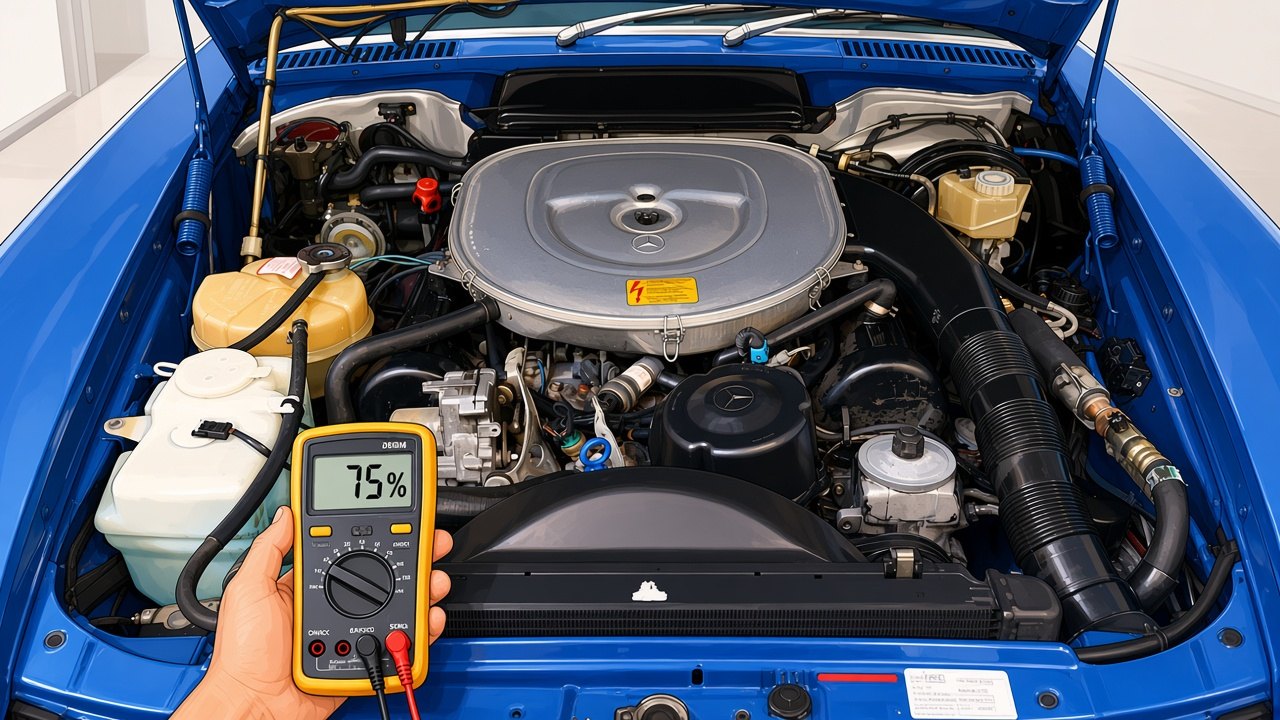
What duty cycle means on CIS-Lambda and KE
On a car with an O2 sensor, the control unit constantly makes the mixture a little richer or leaner to keep the sensor switching. On the 380SL’s CIS-Lambda system, it does this by pulsing a frequency valve. On the 560SL’s KE-Jetronic, it does it by changing EHA current. The diagnostic signal is a pulse whose on-time percentage (duty cycle) tells you how hard the computer is correcting.
- Around 50%: the base mixture is close, and the system has room to correct both ways.
- Low or high but moving: the base mixture is off, and the system is compensating.
- Fixed at one value: the system is in open loop (cold engine, dead O2 sensor, or wiring fault).
Which R107s have it
US 380SLs use K-Jetronic with Lambda control, and US 560SLs use KE-Jetronic with Lambda control. The 450SL does not have closed-loop Lambda control, so this test does not apply.
Where the test port is
Mercedes cars of this era have a diagnostic socket in the engine bay, often marked X11, with several pins. One pin carries the duty-cycle signal. The location and pin assignment changed between years, so check the wiring diagram for your car before you connect anything; the electrical troubleshooting post lists diagram sources.
What meter to use
A digital multimeter with a duty-cycle (%) function is the easiest choice. An old dwell meter also works; 4-cylinder dwell scales are commonly used, and you convert the reading to percent. A purpose-made Lambda tester works too.
Target readings at idle and 2,500 rpm
- Warm the engine fully (thermostat open, fan clutch engaged once).
- Check idle duty cycle.
- Hold 2,500 rpm and check again.
The common target is close to 50% at both, and the two readings within about 10 percentage points of each other. The exact spec and tolerance for your model year are in the factory manual; verify before adjusting.
How to adjust mixture
The mixture is set at the fuel distributor’s adjusting screw, reached through a small hole between the air cleaner and the sensor plate housing, with a long 3 mm hex tool. Many have a steel plug that must be removed first.
- Make tiny changes, a fraction of a turn, then remove the tool and let the reading settle.
- Do not push down on the sensor plate while adjusting; it can stall the engine.
- On the 560SL, the EHA basic setting must be correct first (EHA post).
- Fix vacuum leaks before you touch mixture.
What fixed 50% or 20% readings mean
A reading that never moves is not a “perfect” reading. A fixed value usually means open loop: an engine still cold, a failed O2 sensor, a broken signal wire, or a control unit not powered. On the 560SL, check the OVP relay first. Some readings are fixed by design when the engine is cold or at full throttle, so only judge a fully warm engine at steady idle or 2,500 rpm.