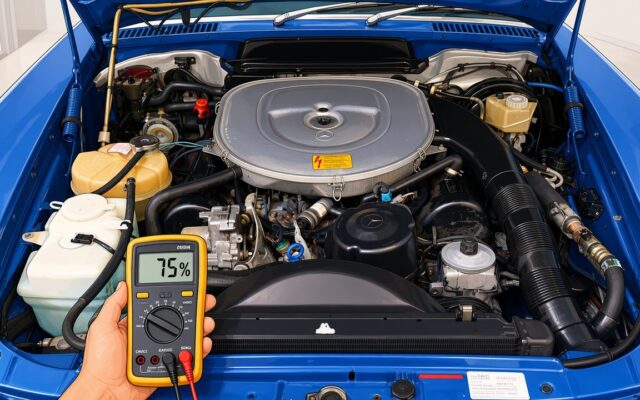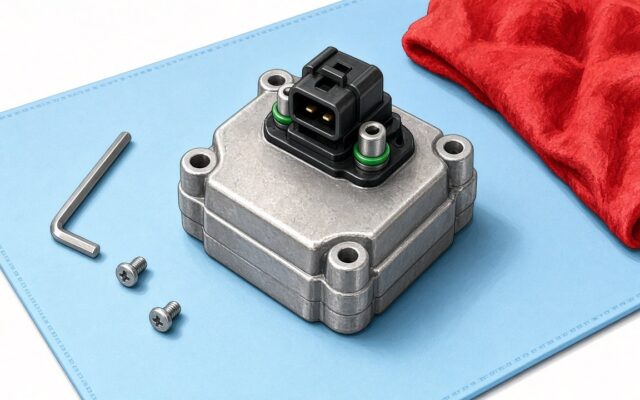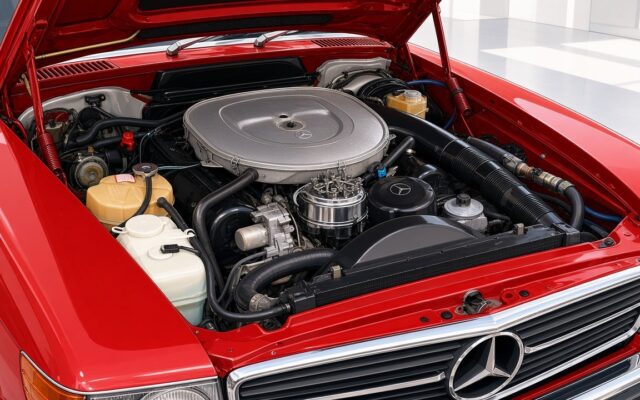
A fuel pressure test is the single most useful test on a K-Jetronic R107. It separates fuel delivery, warm-up regulator and leak-down problems in about half an hour, and it stops you from buying parts by guesswork. Here is how I do it.
What gauge kit to buy
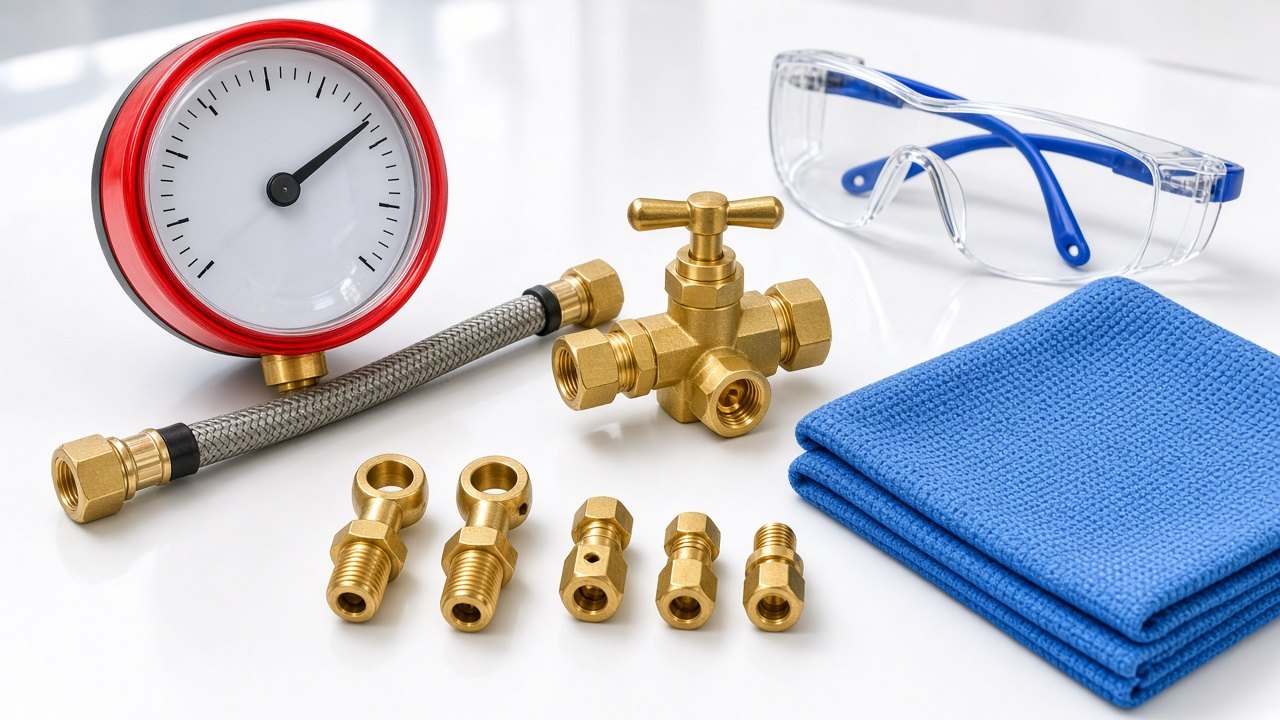
You need a CIS gauge kit, not a simple carburetor gauge. It should have:
- A gauge reading to at least 7 bar (100 psi)
- A three-way valve (tap) in the middle of the hoses
- Banjo and fitting adapters for Bosch CIS lines
Generic kits sold for VW, Volvo, Porsche and Mercedes CIS work if the adapters fit. A CIS pressure test kit is a one-time purchase that pays for itself on the first diagnosis.
Where to tee it in
On a K-Jetronic car (450SL from 1976, 380SL), the gauge goes in the control-pressure line between the fuel distributor and the warm-up regulator. The valve lets you read either system pressure (valve closed: gauge sees the distributor side only) or control pressure (valve open: fuel flows through to the warm-up regulator). On the 560SL’s KE-Jetronic there is no warm-up regulator; the gauge tees into the distributor’s system and lower-chamber test points instead. My KE-Jetronic guide covers that version.
The pressures, explained
- System pressure: what the pump delivers and the distributor’s pressure regulator holds. Too low points to pump, filter, accumulator or regulator.
- Cold control pressure: low when the engine is cold, because the warm-up regulator lowers it to richen the mixture. It depends on temperature, so the manual gives a chart.
- Warm control pressure: rises as the regulator’s heater warms it, usually reaching spec within a few minutes. Too low warm means rich running; too high means lean.
- Rest pressure: what the system holds after shutdown. It should drop only slowly over 10–20 minutes.
Specs differ by engine and year; the factory manual lists them. As a ballpark, system pressure on these cars is usually in the low-to-mid 5 bar range and warm control pressure around 3.4–3.8 bar. Verify for your car.
Step-by-step test
- Engine cold, ideally overnight. Relieve pressure by slowly cracking the line with a rag around it.
- Fit the gauge in the control-pressure line with the valve open.
- Bridge the fuel pump relay (or run the engine) so the pumps run.
- Read cold control pressure and note the ambient temperature.
- Start the engine and watch control pressure rise as it warms.
- Close the valve and read system pressure.
- Stop the pumps, open the valve and time how rest pressure falls over 10 and 20 minutes.
What each bad reading points to
| Reading | Likely cause |
|---|---|
| Low system pressure | Weak pump, clogged filter, failed accumulator, pressure regulator in distributor |
| Cold control pressure too high | Warm-up regulator faulty; hard cold starts and stumbling |
| Warm control pressure low | Warm-up regulator not heating (check its 12 V feed) or worn; rich running |
| Rest pressure drops fast | Pump check valve, accumulator, leaking injector or cold start valve, regulator O-ring |
See warm-up regulator, accumulator and fuel pump for each fix.
Safety
The fuel is under high pressure and sprays as a mist. Work outdoors or with the door open, no smoking, no work lights that can break, a fire extinguisher within reach, and rags around every fitting you crack. Use new copper washers on banjo fittings and check for leaks with the pumps running before you start the engine.
As an Amazon Associate I earn from qualifying purchases.