The earliest R107s use Bosch D-Jetronic, an analog electronic injection system that predates K-Jetronic. Owners of early 350SLs and 450SLs often hear that it is unreliable. Most of that reputation comes from aging wiring and sensors rather than bad design.
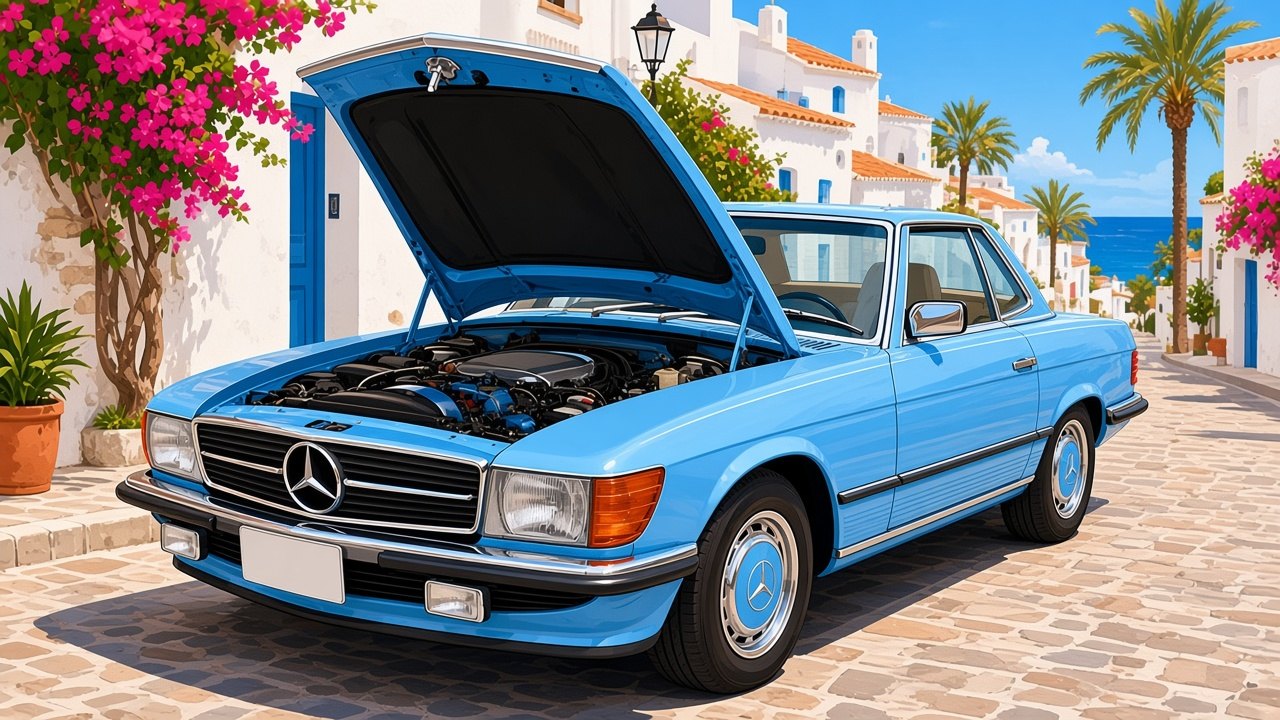
Which years used D-Jetronic
The 350SL and 450SL from launch through the mid-1970s used D-Jetronic. In the US, the 450SL changed to K-Jetronic for the 1976 model year. Check your engine number and data card to confirm which system your car has.
How it differs from K-Jetronic
| D-Jetronic | K-Jetronic |
|---|---|
| Electronic control unit decides injection time | Mechanical metering by air-flow plate |
| Manifold pressure sensor (MPS) measures load | Air-flow sensor plate measures air |
| Injectors pulse electrically | Injectors spray continuously |
| Trigger points in the distributor tell the ECU when to inject | No trigger points |
| Low fuel pressure (about 2 bar) | High fuel pressure (about 5 bar) |
Common failures
- Wiring harness: brittle insulation and corroded connectors are the most common cause of strange running.
- Manifold pressure sensor: a leaking diaphragm makes the car run rich and smell of fuel. It also leaks vacuum.
- Trigger points: worn or dirty points in the distributor cause misfiring or no injection on a group of cylinders.
- Temperature sensors: wrong signals make the car run rich or lean.
- Injectors: old injectors stick or leak.
- Control unit: less common than people think, but capacitors age.
Can it be fixed today?
Yes. Harnesses can be rebuilt, MPS units and ECUs tested and repaired by specialists, and trigger points replaced. Diagnosis starts the same way as any engine: check vacuum leaks, ignition and fuel pressure first. The Bosch D-Jetronic manuals are widely available, and the service manual sources post lists where to find them.
Converting to K-Jetronic or aftermarket EFI
Some owners convert to a later K-Jetronic setup from a 450SL or to a modern programmable EFI. Conversions solve parts problems but cost real money, take time, and reduce originality and possibly value for collectors. A properly sorted D-Jetronic car is pleasant to drive, so I would fix the original system first unless it is beyond saving.
Related reading
Quick answers
- Is D-Jetronic worse than K-Jetronic? Not when it is sorted. It was advanced for its time. The problem is age: fifty-year-old wiring and sensors.
- Does a D-Jetronic car lose value if converted? For a collector-grade early car, originality matters, so a conversion can reduce appeal. For a driver, a well-done conversion matters less.
- What should I test first on a rough D-Jet car? Vacuum leaks (including the MPS hose), ignition, then the trigger points and harness connectors, before suspecting the control unit.
- Are parts still available? Many sensors and injectors are available new, rebuilt or used, and specialist repairers can test and repair control units. Expect to plan ahead rather than buy off the shelf.