As an Amazon Associate I earn from qualifying purchases.
The R107‘s fuel tank is safely tucked behind the seats, but it is also an aging steel tank. Rust inside it causes repeat clogged filters and starved pumps. Here is what owners ask most.
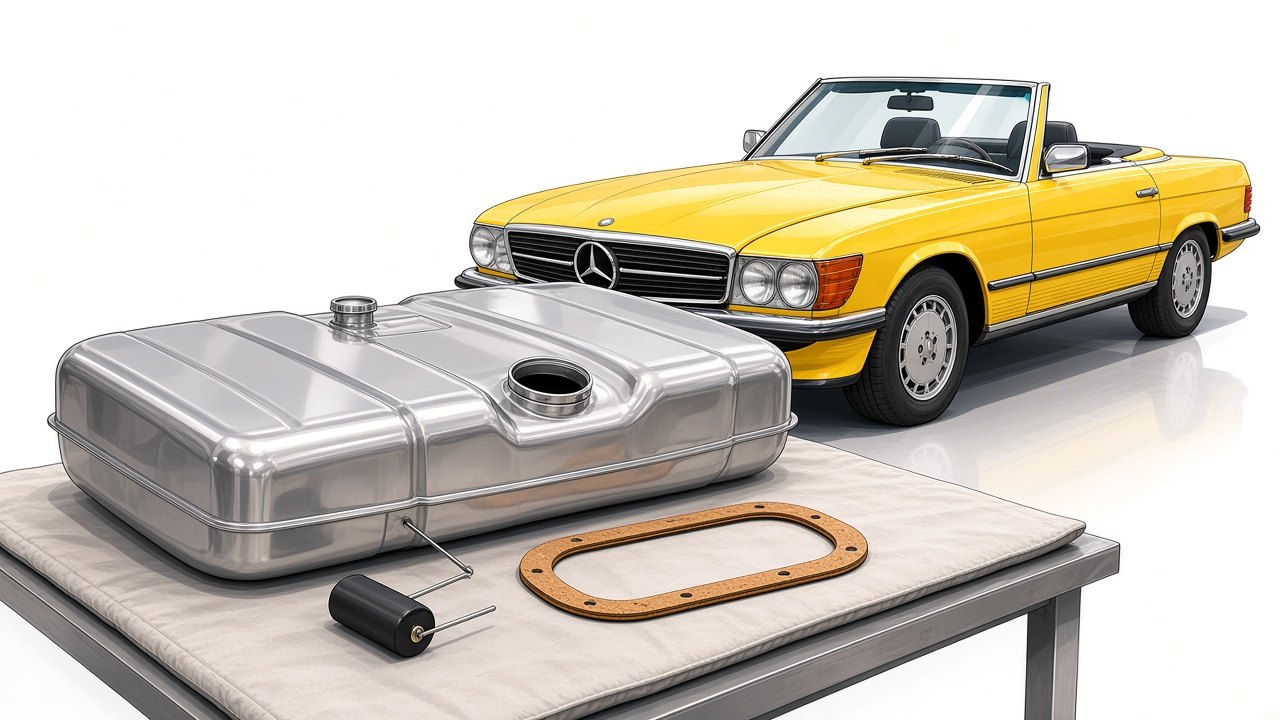
Tank capacity by model
Most R107s have a tank of roughly 85–90 liters, about 22–24 US gallons, with a reserve of about 10–12 liters indicated by the gauge’s warning light. The figure varies slightly by year and market; check your owner’s manual or the factory data for your car.
Where the tank is
It sits behind the seats, between the cabin and the trunk, under the soft-top storage area. The filler neck runs to the flap on the rear panel. The fuel sender is reached from above through an access point under the trim. That location keeps it out of rear impacts but means removal involves interior trim.
Signs of tank rust
- Fuel filters that clog again quickly
- Rust-colored debris in the filter or the pump strainer
- The pump making noise or the car stumbling on a low tank
- Visible rust around the sender opening when you look in with a flashlight
- Fuel weeping at seams or the bottom of the tank
Cleaning vs replacing
If the rust is light and the tank is not leaking, a professional clean and internal coating is a sound option. Light surface rust can also be handled with a proper tank-cleaning kit. If the tank leaks, has pinholes, or is heavily scaled, replace it. New and good used tanks are available. Whatever you choose, change the fuel filter after the work and again after a few hundred miles.
Removal outline
- Drain the tank (run it low first) using the drain plug or by siphoning through the pump line.
- Disconnect the battery and remove the trim and panel behind the seats.
- Disconnect the sender, the supply and return lines and the vent lines.
- Remove the filler neck connection and the tank straps or bolts.
- Lift the tank out carefully; it is awkward rather than heavy.
Fuel vapor is the hazard here. Work outdoors or with plenty of ventilation and no ignition sources.
Sender and strainer
The sender unit carries the float, and many tanks have a strainer at the outlet. Clean or replace the strainer while the tank is out, and test the sender before refitting; see fuel gauge not working.
Quick answers
- How far can an R107 go on a tank? It depends on model and driving; multiply your measured mileage (see real MPG) by usable capacity and keep a margin, because the reserve light is not precise.
- Is a tank sealer a permanent fix? A professional cleaning and coating can last many years. A badly applied sealer can peel and clog the strainer, which is worse than the rust.
- Should I store the car with a full tank? A full tank of fresh, stabilized fuel limits condensation over winter; see winter storage.