A dead or erratic fuel gauge is common on the R107, and it is almost always fixable without replacing the gauge itself. The fault is usually the sender in the tank or the ground circuit.
Why gauges fail
- The sender’s resistance wire wears or breaks where the wiper rubs most (usually the middle of the range)
- Corrosion on the sender connector or its ground
- A float that sticks or fills with fuel
- Rarely, the gauge in the instrument cluster
How to reach the sender
The sender sits in the top of the fuel tank, which is behind the seats under the soft-top storage area. Lift the trim and the access cover. With the tank less than full, you can remove the sender without draining it. Disconnect the battery and keep sparks away.
Ground and connector checks
- Look at the sender’s connector for green corrosion. Clean it.
- Check the ground wire and its body connection.
- With the ignition on, unplug the sender and short the gauge wire to ground briefly; the needle should swing one way, and opening it should swing it the other. If it does, the gauge and wiring are fine and the sender is the problem.
Bench test
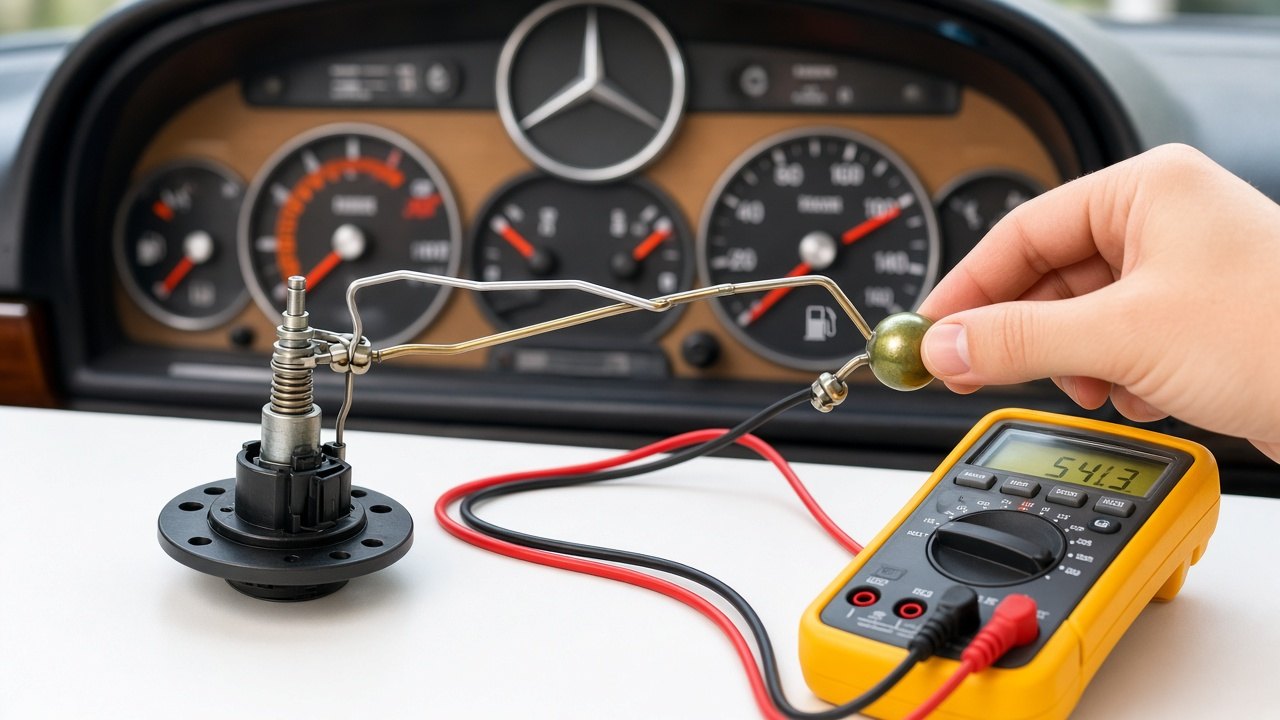
Remove the sender and connect an ohmmeter. Slide the float slowly from empty to full. The resistance should change smoothly without dropouts. A sudden jump to open circuit at one point means a broken or worn wire. You can also reconnect the plug with the sender out of the tank, ignition on, and watch the gauge as you move the float.
Repair vs replace
Some owners clean and re-tension the wiper or repair the resistance wire, and there are services that rebuild senders. A new sender is the quicker answer if yours is badly worn. Use a new gasket when it goes back in.
Reserve light behavior
The low-fuel warning comes from the sender too. If the reserve light stays on with a full tank or never comes on, test the same sender and connector. A light that flickers on corners near a quarter tank is normal.
Related reading
Quick answers
- Can a bad ground make the gauge read full all the time? A poor ground or open circuit in the sender usually sends the needle to one end of the scale. Check the ground first.
- Does the instrument cluster need to come out? Rarely. Prove the sender and wiring are fine first; if the gauge still does not move when you ground its wire, then look at the cluster (instrument cluster removal).
- Is it safe to drive with a dead fuel gauge? Only if you reset your trip odometer at every fill-up and refill well before the tank could be low. Running a K-Jetronic car dry is hard on the pumps.
- Will a new sender read exactly like the old one? Aftermarket senders sometimes read slightly differently at the top or bottom of the scale. Note where the needle sits after a full fill.