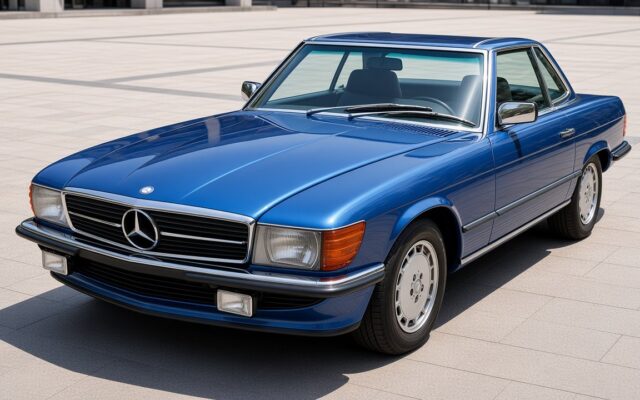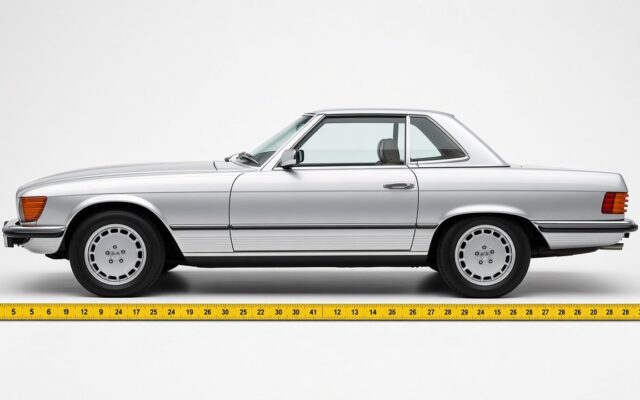
The R107 used many different rear axle ratios during its 18-year run. Mercedes changed them for different engines, markets and fuel economy targets. Knowing your ratio explains how your car accelerates and cruises.
Ratios per model
These figures are compiled from published differential tables. Ratios varied by market and production date, so verify your car’s ratio.
| Model | Typical ratio |
|---|---|
| 280SL | 3.69 or 3.92 (manual), 3.58 later |
| 350SL | 3.46 |
| 450SL (to Dec 1973) | 3.07 |
| 450SL (from Jan 1974) | 3.06 |
| 450SL (US 1980) | 2.65 |
| 380SL (1980–1981, some markets) | 3.27 |
| 380SL (1981–1985) | 2.47 |
| 500SL (1980–1981) | 2.72 |
| 500SL (1981 on), 420SL | 2.24 |
| 300SL | 3.46 |
| 560SL (US, Australia, Japan) | 2.47 |
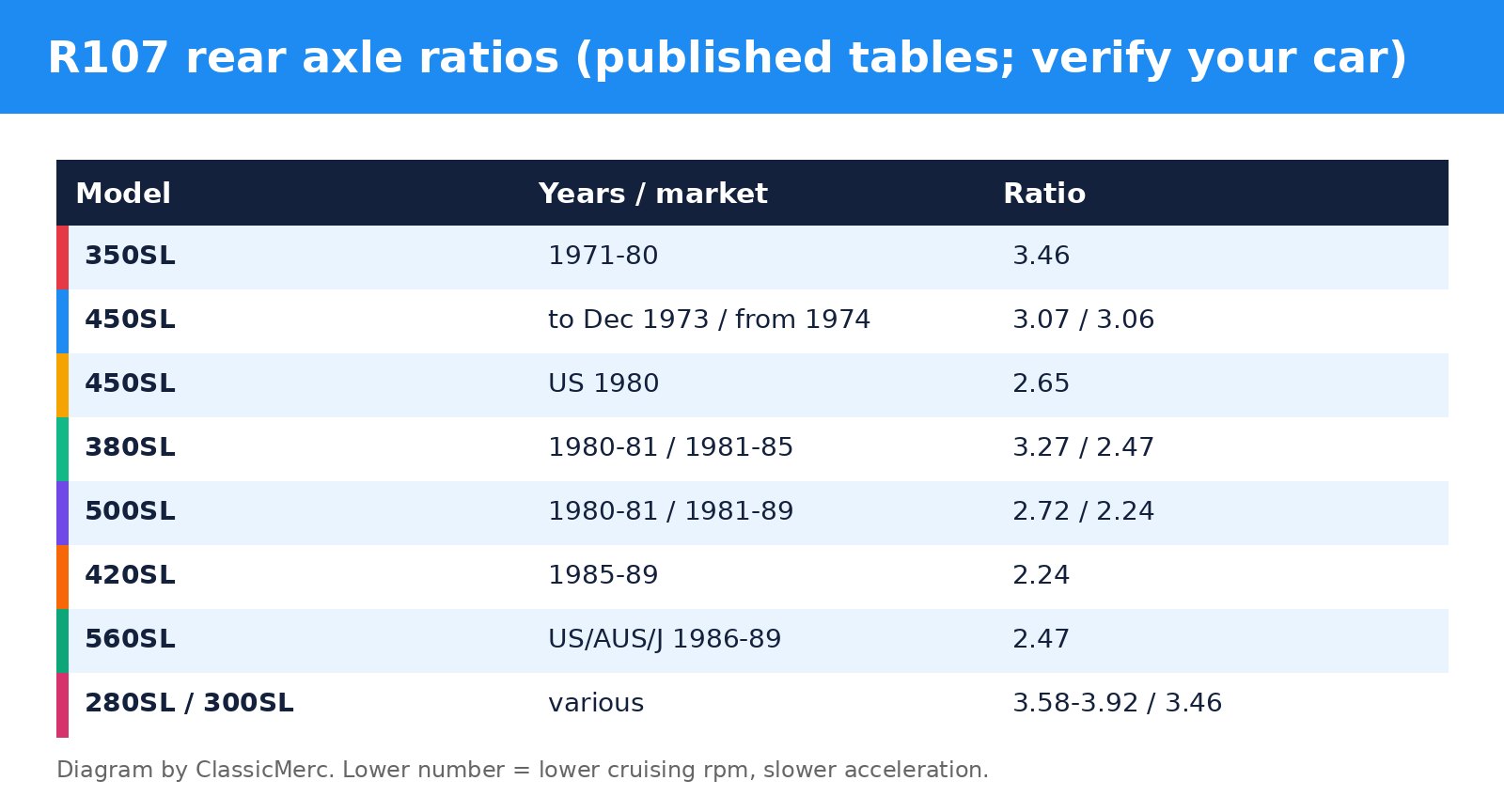
From 1981, Mercedes moved many V8 models to much taller (numerically lower) ratios as part of a fuel efficiency program, which is why later 380SLs and 500SLs have such tall gearing.
How to identify your ratio
- Data card: may list the axle code.
- Differential tag or stamp: many differentials have a tag or stamped number with the ratio or a code.
- Count rotations: with both rear wheels safely off the ground and the transmission in neutral, mark the driveshaft flange. Turn both rear wheels together, in the same direction, exactly one full turn, and count the driveshaft turns. About 2.5 turns means a 2.47 ratio; about 3 turns means 3.06 or 3.07.
Effect on acceleration and economy
- A numerically higher ratio (such as 3.06) gives quicker acceleration and higher rpm at highway speed.
- A numerically lower ratio (such as 2.47) gives lower rpm at cruising speed and better economy, but slower acceleration.
This is why a 380SL with a 2.47 ratio feels relaxed on the highway but less lively from a stop.
Swapping
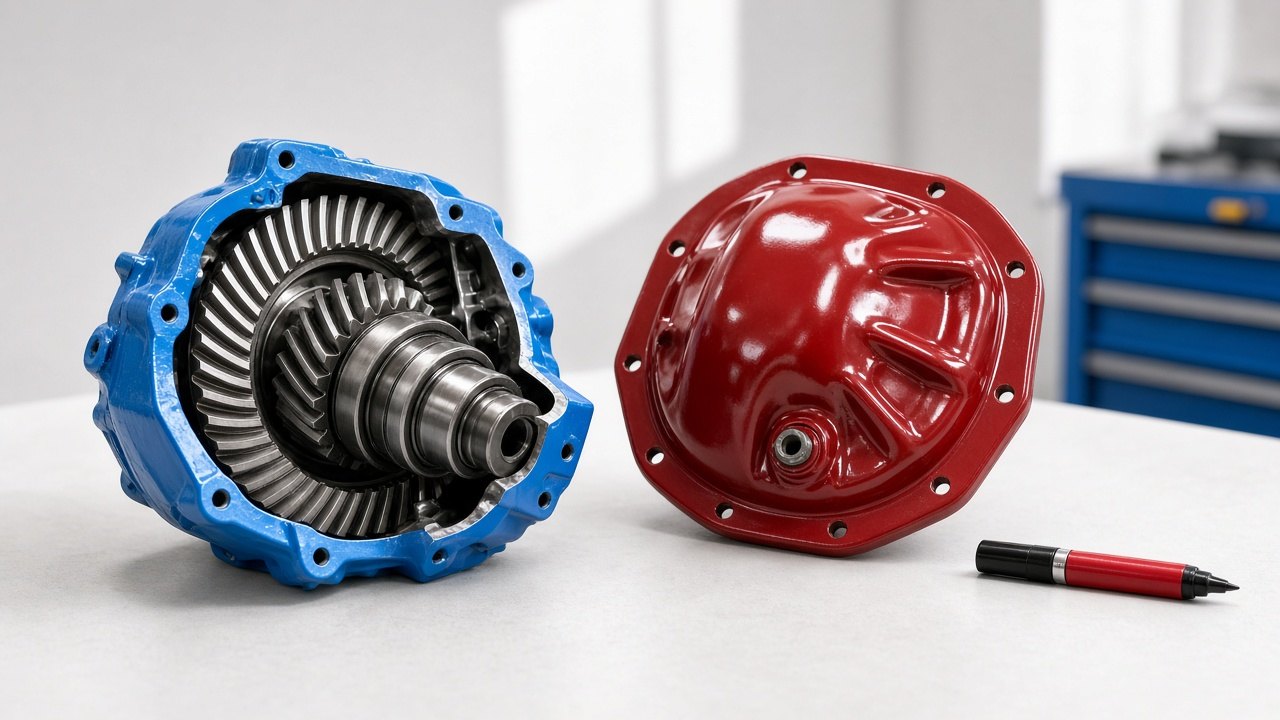
Some owners swap a different ratio differential to improve acceleration, for example fitting a numerically higher ratio to a 380SL. Points to check:
- Case size and mounts: V8 models use a larger differential case; parts must match.
- Speedometer: a different ratio affects speedometer accuracy, depending on how the speedometer is driven.
- Axle shafts and flanges: must fit.
- LSD or open: see differential.
Get the differential from a known donor with a confirmed ratio.
Quick answers
- What is the best ratio for a 380SL? It depends on use; many owners like a numerically higher ratio for acceleration.
- Does a ratio swap affect fuel economy? Yes, a numerically higher ratio raises cruising rpm.
- Can I use a W126 differential? Some W126 V8 differentials share ratios and case sizes; verify fit by part number. See parts interchange.
- Is the 560SL ratio the same as the 380SL? Published tables list 2.47 for both.