As an Amazon Associate I earn from qualifying purchases.
Buying a Mercedes W123 is less about finding a shiny paint job and more about saying no early. I treat every listing the way I treat an R107 buying lead: guilty until the rust, vacuum system, and paperwork say otherwise. This is the W123 buying pillar — which body style to chase, the rust order I check, diesel versus gas tradeoffs, vacuum quirks, and the red flags that end the deal before money changes hands.
Related: W123 rust check, W123 vs W124, 300D / OM617 guide, R107 rust check.
What the W123 actually is
The W123 family (mid-1970s into the mid-1980s, depending on market) was Mercedes’ volume mid-size car: sedans, coupes, and wagons built like bank vaults by the standards of the day. US buyers mostly meet diesels — 240D, 300D, 300D Turbo, and the wagon and coupe variants. Europe and other markets saw more gasoline fours and sixes. Production volume was huge, which is good news for parts and community knowledge and bad news if you assume every survivor was cherished. Plenty of taxis and high-mile cars still exist. That is fine — if the structure is solid and the maintenance story is honest.
If you are coming from an R107 SL, expect a different job. The W123 is a practical classic: doors that close with a thunk, seats you can sit in for hours, and performance that will not impress anyone at a stoplight. The upside is durability and a deep DIY culture on forums like PeachParts.
Which W123 to target
Pick the car for how you will use it, not for the prettiest listing photo:
- Daily or long-distance workhorse: a 300D or 300D Turbo with records. Slow, tough, and economical to keep on the road when the metal is honest.
- Wagon life: 300TD / 300TD Turbo. Measure the self-leveling suspension (SLS) carefully — pump noise, rear sag, and leaking spheres are negotiating points or walk-aways.
- Style over space: 300CD coupe. Thinner market, nicer proportions, same rust and vacuum rules.
- Gasoline six: 280E and similar. More highway pace; different fueling and ignition habits than the OM617 crowd.
- Entry diesel: 240D. Even slower, often cheaper, still subject to the same body checks.
There is no single “best” W123. There is a best car for your climate, budget, and tolerance for vacuum plumbing.
Approximate market context
Sold prices beat asking prices. Looking at public US auction compilations into 2026, ordinary W123 sedans often change hands from the high four figures into the mid-teens. Tidy 300D Turbo sedans have clustered around roughly a $10,000 median on Bring a Trailer–style results in recent multi-year samples, while nicer coupes can land nearer the high teens. Exceptional low-mile or show-quality cars go much higher; projects go much lower. Use those bands to sanity-check a listing, not as an appraisal of the specific car on the lift.
Rust spots (in the order I check)
- Front fenders and wheel arches, especially leading edges and lips
- Sills / rocker panels and jacking points — if a jack sinks, stop
- Battery tray and the bulkhead area it can infect
- Spare-wheel well and trunk floor
- Rear window lower corners and parcel-shelf area on sedans
- Sunroof tray and drain tubes if equipped
- Estate tailgate edges and lower corners on wagons
- Floor pans under carpets and around seat mounts
- Fuel tank, straps, and whether a rusty tank is already a parts hunt
A full spot-by-spot walkthrough is in the W123 rust check. Soft underseal and fresh paint hide bad metal. Lift carpets with permission and look with a bright light — the same discipline as an R107 rust check.
Vacuum system (central locking and friends)
W123 comfort systems lean on vacuum: door locks, trunk lock, and on coupes the seat-back locks tied into the system. Ask the seller to lock and unlock every door and the trunk from the driver’s control. Weak, slow, or silent actuators usually mean cracked hoses, failed door pods, check valves, or a tired vacuum source (diesels use a pump). Do not assume “it just needs a fuse.”
Vacuum leaks also show up as rough idle, confused climate flaps, and odd automatic shift feel on some cars. Budget a refresh of rubber and a diagram-based diagnosis. It is fiddly, not mystical.
Diesel checks (OM616 / OM617)
- Cold start: glow plugs and relay. Hard winter starts with white smoke can be glow time, compression, fuel delivery, or timing — diagnose before throwing parts.
- Timing chain: listen cold. Ask for invoices. A light tick is not automatically catastrophic, but unanswered chain questions get priced into the deal. More in the 300D / OM617 guide.
- Oil: seepage at covers is common; puddles, metallic glitter, or low pressure are not.
- Turbo models: shaft play, oil in the intake tract, cracked boost hoses, and oil-change history. A cheap turbo car with unknown service is not a bargain.
- Compression / leakdown: worth paying for on any non-running or “easy fix” diesel.
Gasoline notes
Gas W123s bring mixture, idle, and ignition age into the story. If you already own an R107, some diagnostic habits transfer and some do not. Use a year-correct diagram. Do not parts-cannon a W123 using only an R107 common-problems list.
Driveline, brakes, and wagon SLS
- Automatic: smooth when warm, no flare, no harsh bang into drive or reverse. Fluid should not smell burnt.
- Manual: rarer in the US; check clutch take-up and synchros on a proper road test.
- Brakes: firm pedal, straight stops, no grinding. Hoses, calipers, and master cylinders are age items.
- Steering and front end: play, idle-arm wear, and uneven tire wear tell you about deferred maintenance.
- Wagon SLS: pump behavior, rear height after loading, leaks at spheres and lines. Sagging rear = budget or goodbye.
Interior, electrics, and paperwork
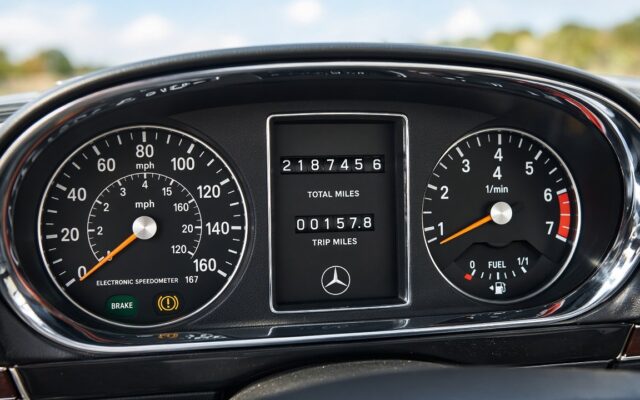
MB-Tex survives decades of use better than cloth or velour, which are harder to restore convincingly. Check seat bolsters, dash top cracks, window regulators, and whether pedal and seat wear roughly match the odometer story — W123 odometers are a known weak spot. Test blower speeds, gauges, and lights. Demand a clean title and skepticism toward “always garaged” claims that do not match the underside.
A factory data card from Mercedes-Benz Classic is useful on nicer cars. It confirms original color and options; it does not replace a lift inspection.
Pre-purchase inspection
Pay a Mercedes-literate independent shop, not a general used-car lane. Ask for compression on diesels, a written note on jack points and sills, and a vacuum/electrical sanity check. The habit matches an R107 PPI: money before the title beats surprises after. If the seller refuses a lift, that is information.
Red flags that end the deal
- Jack sinks into a sill or jacking point
- Battery tray rusted into the bulkhead
- Seller blocks carpet pulls, blower-area looks, or a shop inspection
- Non-running “needs a battery” diesel with no compression numbers
- Fresh undercoating everywhere you needed to inspect
- Salvage or unclear title stories that do not match the metal
- Wagon with a silent SLS pump and a rear that sits on the bumps
Quick answers
- Is a W123 a good first classic Mercedes? Yes — if the structure is solid and you accept vacuum and age-related rubber work. Compare with the W123 vs W124 guide.
- Diesel or gas? Diesel for US parts community depth and longevity reputation; gas if you want more pace and accept different fueling work.
- How many miles is too many? On a cared-for OM617, high miles are normal. Rust and neglected maintenance kill more cars than the odometer.
- What should I budget after purchase? Fluids, filters, glow plugs, brakes, rubber, and a vacuum refresh — then whatever the PPI found. Ownership mindset: what older Mercedes ownership really costs.
- W123 or R107? Different jobs: sedan/wagon practicality versus SL roadster weekends. Read both buying guides before photos win.
Related reading
- Where Does a W123 Rust?
- Mercedes 300D (OM617) guide
- W123 vs W124
- R107 buying guide
- W123 vacuum door locks
- 300TD wagon
- W123 as a daily driver
- W123 timing chain
- Best classic Mercedes 2026