Ignition faults on an R107 often look like fuel injection faults: stalling, cutting out when hot, misfiring under load. Testing the coil and module first can save a lot of money on fuel parts.
Which ignition system each model uses
- Early cars: breaker points and a conventional coil, sometimes with a ballast resistor.
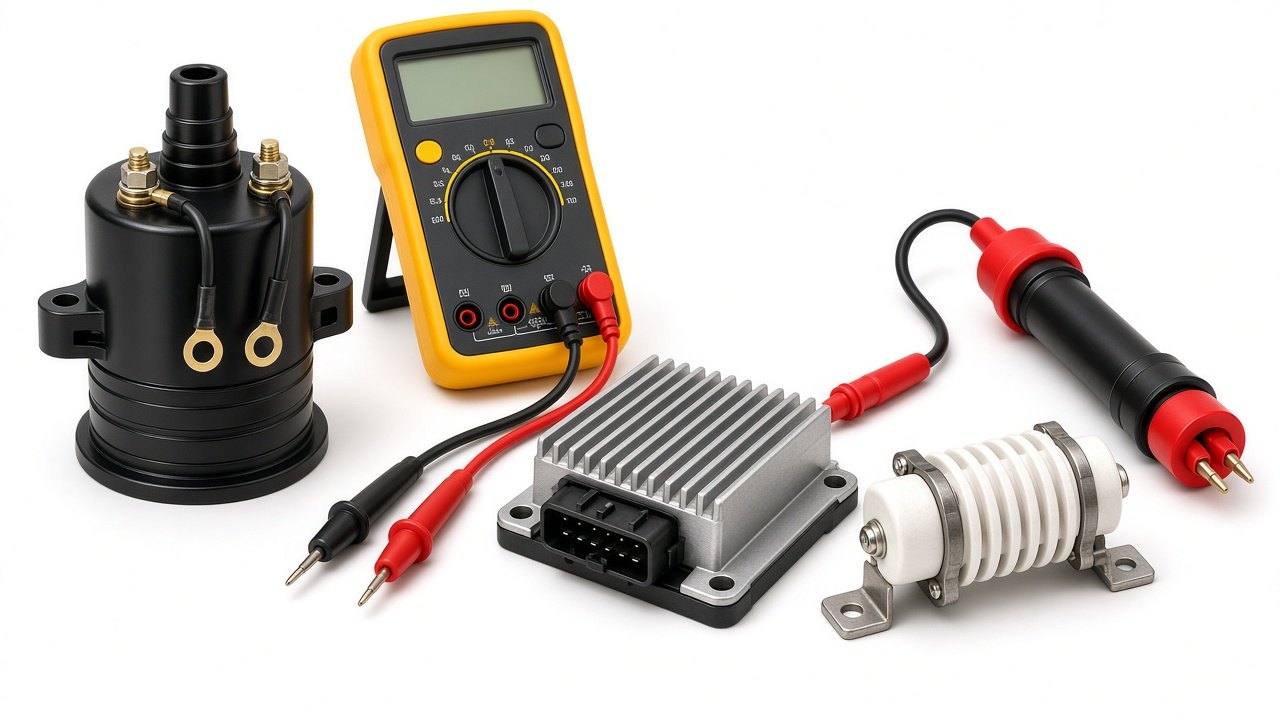
- Mid-1970s onward: transistorized ignition with an ignition switch unit (module) and a matching coil, often with one or two ballast resistors.
- Late cars, including the 560SL: electronic ignition control with a control unit that manages timing advance (often called EZL), with inputs from engine speed, load and temperature.
Check your engine and year in the catalog before buying.
Symptoms of coil or module failure
- Engine cuts out when hot, restarts after cooling
- Misfire under load or at higher rpm
- No spark at all
- Hard starting that improves with the engine cold
How to test
- Spark test: with a proper spark tester, check for strong spark at the coil wire while cranking.
- Coil resistance: measure primary and secondary resistance and compare to the spec for your coil. Coils for transistor ignition have very low primary resistance and need the right ballast resistor.
- Ballast resistor: check resistance and connections; corroded terminals are common.
- Module power and ground: check for 12 V at the module with the key on, and a clean ground. Modules mount on a heat sink and need good contact.
- Hot test: if it fails only when hot, use a heat gun carefully on the module or coil while watching spark.
Ballast resistor
Many transistorized systems use a ballast resistor block. If it fails, the engine may run only while cranking or not at all. Never bypass it permanently on a system designed to use one.
560SL control unit
The 560SL’s ignition control unit sits in the engine bay and controls timing. Faults can cause poor power or knocking. Check vacuum lines and connectors first; units can be tested by specialists.
Replacement
Use the correct coil for your module. A mismatched coil can overheat the module. Mount modules with heat-sink compound where specified.
Quick answers
- Can I use a high-output coil? Only if it is compatible with your module and ballast.
- Does an ignition fault set a code? These cars do not have modern self-diagnosis; testing is manual.
Related reading
- Tune-up: cap, rotor, wires and timing
- Won’t start checklist
- Why does the car cut out on hot days only? Heat-sensitive coils and modules are a classic cause. Test spark while the engine is hot and failing, not after it has cooled.
- Can a bad ground cause ignition faults? Yes. The module needs a clean ground through its mounting and wiring; corrosion can cause intermittent cut-outs.