
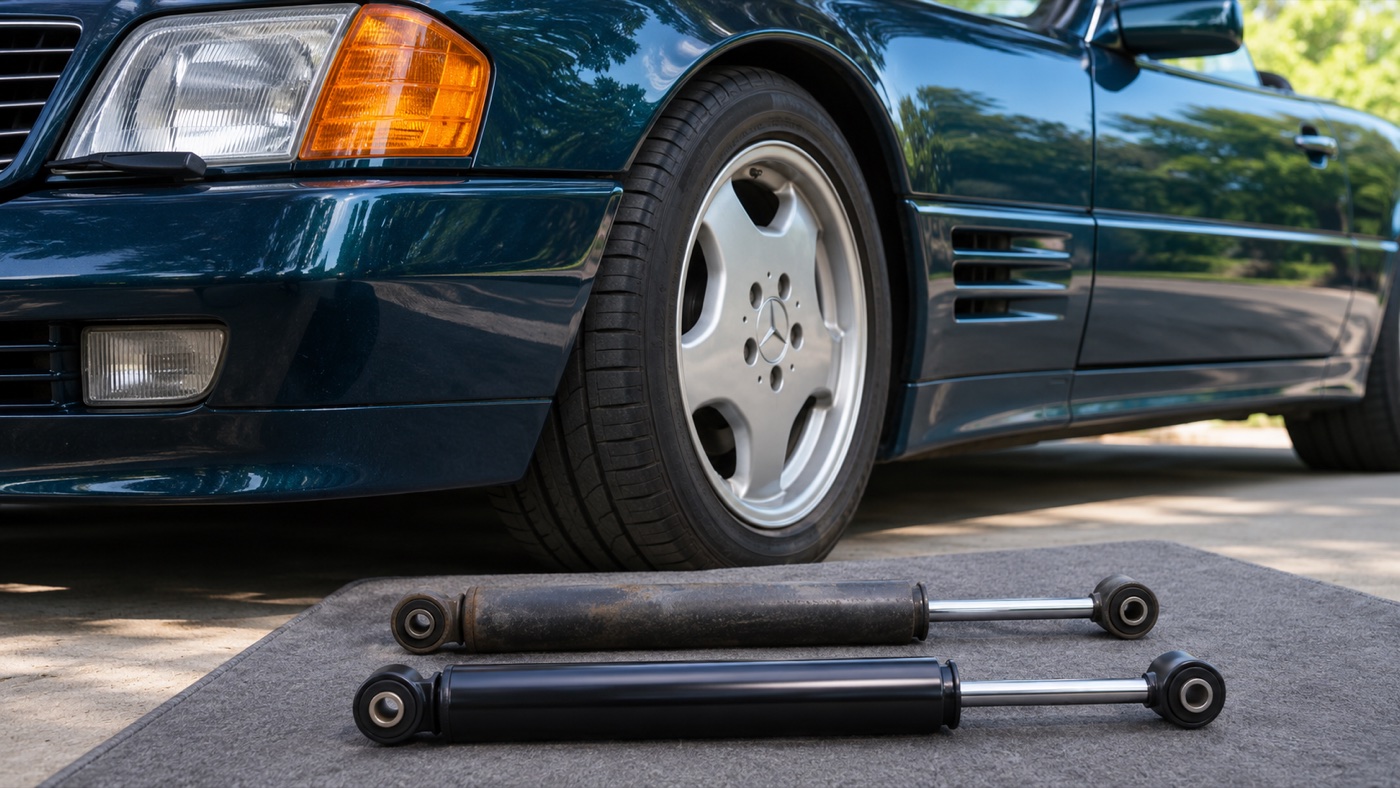
You notice a knock or extra bounce in your classic SL, and the workshop recommends a new shock absorber. Should you replace the other one too? Mercedes has a surprisingly practical answer: it depends on the fitted suspension, the condition and mileage of the components, and whether the replacement part has been standardized.
The R129 was introduced at Geneva in 1989 and brought the Adaptive Damping System (ADS) into Mercedes production. ADS adjusts damping to driving conditions and works with automatic self-leveling. The R129 also came with conventional suspension. Before you buy anything, confirm what equipment is actually fitted to your car.
Why matching the dampers matters
A spring lets the wheel move over a bump and supports the car. The damper, commonly called the shock absorber, controls the resulting motion so the car settles rather than continuing to oscillate. A change in how your SL settles after a bump can indicate that something needs attention.
If one damper has lost effectiveness, installing a fresh part on that side may leave a noticeable difference in damping across the axle. But two components with the same service age aren't necessarily both damaged. That distinction is at the heart of Mercedes' replacement guidance.
What Mercedes recommends
Mercedes-Benz service bulletin S-B-32.25/82c, issued June 4, 2013, covers model 129 among several chassis. It explains the general policy for replacement, not the full workshop operation for changing an R129 damper.
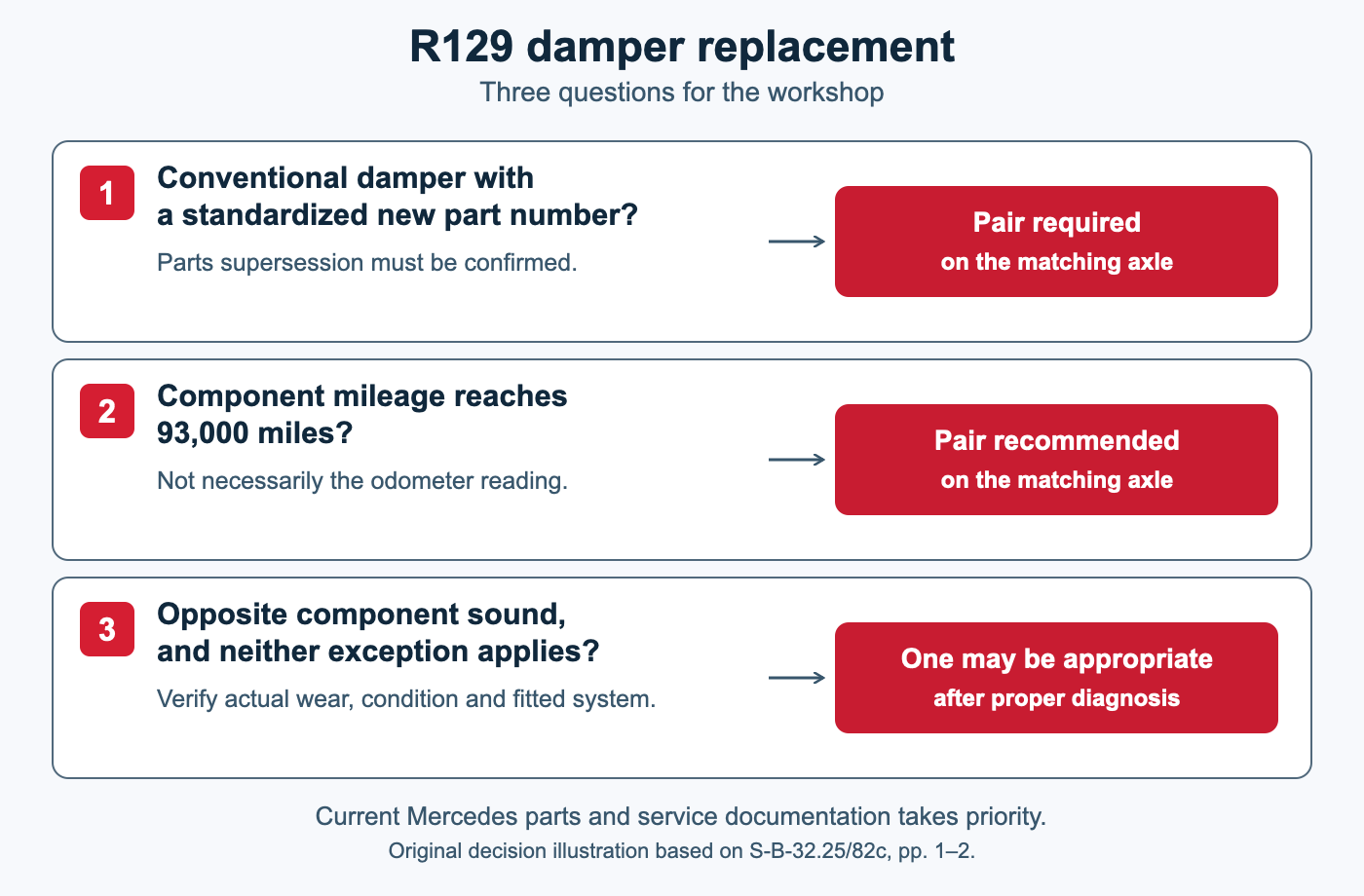
Start with diagnosis; damage on one side is not proof that the corresponding part on the other side has failed. The following three questions match the numbered decision illustration.
- Check conventional-suspension replacement part numbers. If Mercedes consolidated the available damper variants and your replacement has a standardized new part number, the bulletin requires pair replacement for the conventional model 129 suspension. This requirement does not depend on reaching the mileage threshold.
- Look at component mileage. Mercedes recommends replacing the matching pair once a component reaches 93,000 miles because the damping behavior of the used and new components may differ. The ADS strut on model 129 is covered by the bulletin's variant guidance.
- Consider the corresponding component. If the other damper is sound and neither exception applies, replacing only the affected component may be appropriate, subject to the current factory documentation.
A replacement pair means the corresponding components on the same axle, not automatically all four. The 93,000-mile figure is a replacement-policy threshold, not a scheduled service life or a guarantee that a damper will last that long. If your odometer reads 110,000 miles but a damper was changed 15,000 miles ago, its component mileage is not 110,000.
A knock is not automatically a failed shock absorber
A worn mount or another component nearby can make noise as well. Get the source of a knock identified, rather than buying replacement parts and hoping the sound goes away.
If the car feels unstable, has an unusual ride height or displays a suspension warning, arrange an inspection instead of assuming you can keep driving it. This is especially important with hydraulic suspension. Do not open hydraulic lines or release suspension spring tension yourself: the necessary repair procedure depends on the actual suspension fitted and must be handled by a technician using the appropriate equipment.
What to ask before ordering parts
- Does my VIN and installed equipment identify conventional suspension or ADS?
- Is the trouble actually in a damper, its mounting, or another component?
- How far have the affected components traveled since installation?
- Do the current Mercedes replacement part numbers supersede the originals, or combine previously distinct variants?
- Is the proposed one-side or paired replacement consistent with current Mercedes parts and technical information?
If your service records are incomplete, ask the workshop to assess the matching damper rather than assuming its mileage. Current Mercedes parts and service documentation take precedence where it modifies the bulletin's guidance.
Helpful tools for a preliminary inspection
If you do not already have these tools, here are two useful options available on Amazon (affiliate links). I may earn a commission from purchases made through these links.
- Rechargeable LED inspection light — for looking through the accessible wheel area in good lighting while the vehicle is parked.
- Telescoping inspection mirror — for seeing an accessible obscured surface without reaching into the suspension.
These are general tool search listings for non-invasive observation, not a substitute for professional diagnostic equipment. Do not crawl under a vehicle that isn't properly supported.
Factory references
- Mercedes-Benz Star Bulletin S-B-32.25/82c, June 4, 2013, pages 1–2. Section 1 addresses diagnosis and component replacement; Section 2 covers the variants, mileage threshold and standardized parts; Section 3 directs the reader to current Mercedes parts and technical documentation.
- Mercedes-Benz R129 history, March 21, 2019, for the R129 debut and ADS background.
If you are comparing this SL with its predecessor, see R107 versus R129. Their suspension equipment and repair procedures are not interchangeable.