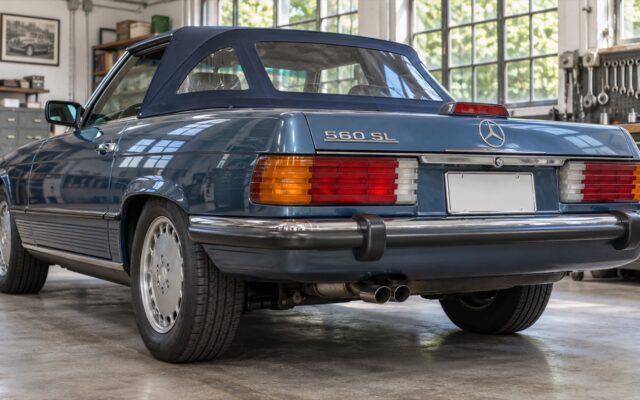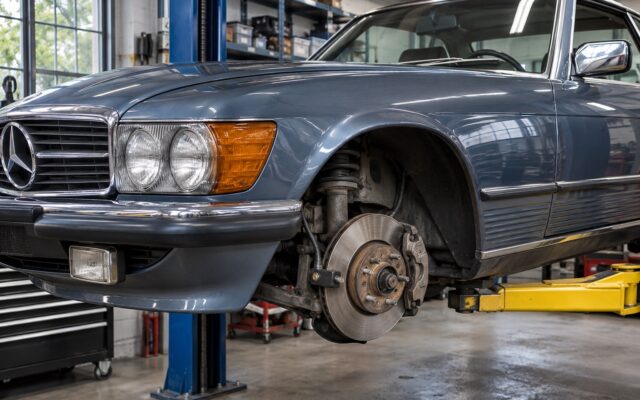

If your classic Mercedes has an ABS warning light, don’t buy an ABS pump just yet. A failed relay, poor electrical connection, low supply voltage or a wheel-speed sensor can disable ABS even when the hydraulic unit itself is sound. A proper diagnosis can save you the expense of replacing a perfectly good part.
The hydraulic unit is the part that actually changes the pressure at the brakes when the anti-lock system intervenes. If diagnosis confirms that the unit must be replaced, Mercedes has a factory replacement procedure for the Model 107, identified in its workshop manual as 42-705. That number is simply Mercedes’ catalog number for the repair instructions.
This guide applies to an ABS-equipped Model 107 with the three-channel system described below. Check the equipment fitted to your particular car, its production date and the part identification before ordering anything. Earlier cars were not necessarily equipped with ABS.
What makes this system special?
In 1978, Mercedes-Benz and Bosch introduced their digital ABS. It became optional on the 116-series S-Class later that year; Mercedes says it extended the option across its passenger-car range two years later. The technology gave drivers a better chance of retaining steering control under hard braking on slippery roads.
On the Model 107, the hydraulic unit works between the master cylinder and the wheel brakes. Think of the master cylinder as the source of the braking pressure your foot requests. The ABS unit does not make that request bigger. Instead, when a wheel is approaching lockup, it temporarily limits or reduces the pressure delivered to that wheel.
There are two independently controlled front brake channels and one shared rear brake channel. Three electrically operated valves inside the unit regulate them. The electronic controller, a separate component, decides when to intervene using signals from the two front wheel sensors and the rear axle sensor.
What happens inside the hydraulic unit?
Imagine your right front tire reaches a wet patch during a hard stop. The system detects an unusually rapid reduction in wheel speed and adjusts the brake pressure rather than letting that tire remain locked.
| Stage | What happens |
|---|---|
| Pressure builds | The channel allows pressure from the master cylinder to reach the brake. |
| Pressure holds | The valve temporarily isolates the wheel circuit so that brake pressure does not keep increasing. |
| Pressure reduces | Fluid is released into a reservoir and the return pump circulates it back toward the master cylinder. |
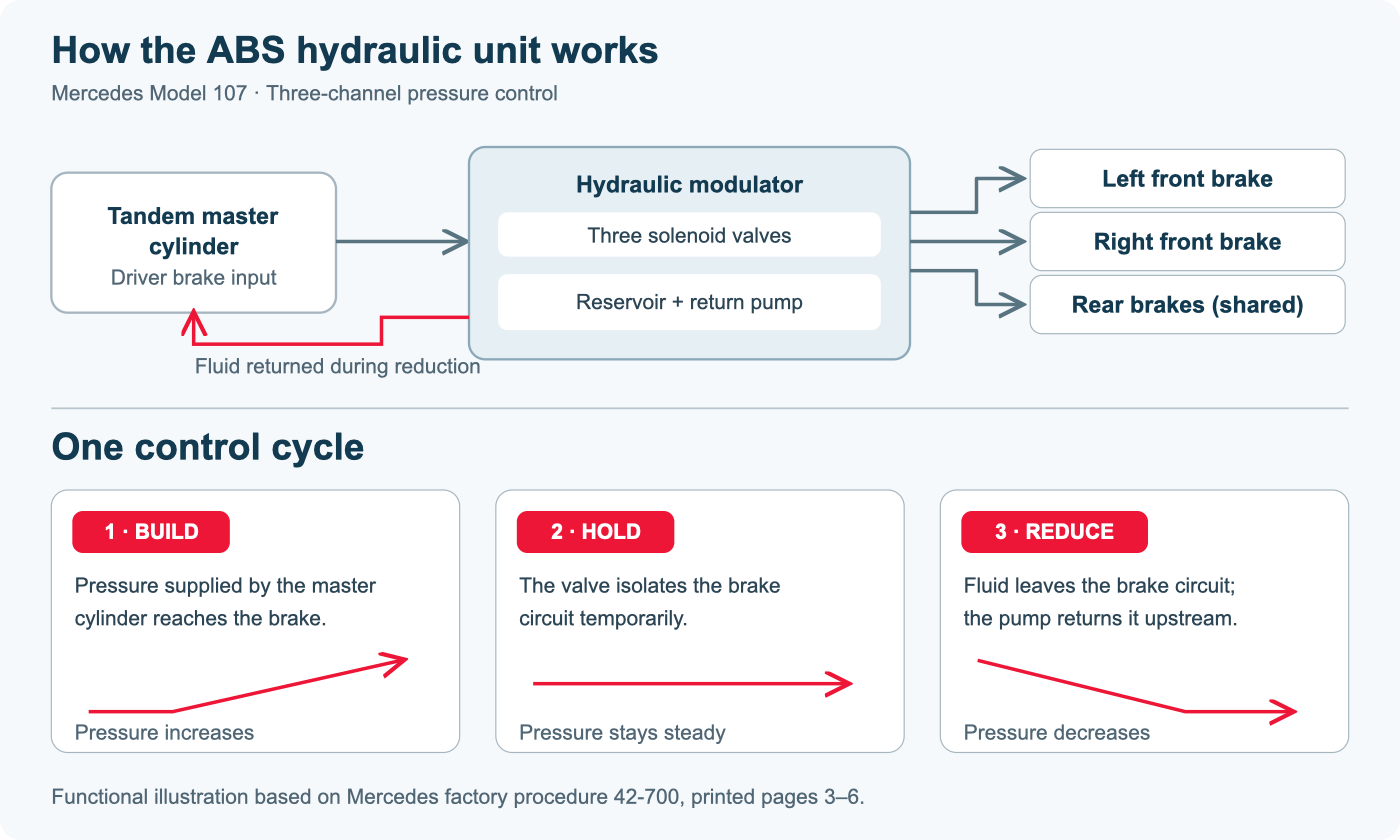
Once the wheel begins to recover, the pressure can increase again. The controller repeats this cycle as needed. This is why you may feel the brake pedal pulse while ABS is working. It is not, on its own, proof that the pump is failing.
The important distinction is that the pump, valves, electronic control unit and sensors perform different jobs. The ABS warning lamp cannot tell you which one is at fault by itself.
Does an ABS warning light mean the pump is bad?
No. An illuminated ABS lamp generally tells you anti-lock protection is unavailable, not which component caused that condition. The original 1988 560SL owner’s manual explains that ordinary hydraulic brakes remain available without anti-lock assistance; have the fault checked promptly. The factory’s system description also explains that a low electrical supply can temporarily disable the system. A permanent electrical fault may keep the warning on until the ignition is switched off.
A sensible diagnosis begins with recording when the warning occurs, whether it is intermittent or persistent, and whether the ordinary brakes feel normal. The workshop’s factory test procedure 42-720 includes checks of the valve and pump relays, connections and grounds, overvoltage protection, solenoid-valve resistance, and speed sensor circuits. The equipment and test sequence depend on the control-unit version. This is why generic modern OBD advice or simply swapping the pump is not an adequate substitute.
A specialist can distinguish among:
- A supply or ground fault that prevents ABS from operating.
- A faulty relay or connection in the hydraulic assembly.
- A sensor or sensor-wiring fault that deprives the controller of reliable speed information.
- A confirmed fault in the hydraulic modulator or its valves.
If the pedal is soft or sinks, braking is abnormal, or you see brake fluid leaking, treat that as a brake-system problem rather than an ordinary ABS warning. Don’t drive the car until the brakes have been checked.
Can the ABS hydraulic unit be repaired without replacing it?
Some electrical parts are serviceable. In factory procedure 42-710, Mercedes identifies the return-pump relay (15) and valve relay (16) as separately replaceable with the ignition off. The separate voltage-protection components are also covered.
Be particularly careful when sourcing relays for later cars. The manufacturer describes a modification phased in early in 1986: the valve relay has six terminals instead of five, with the diode incorporated into the relay rather than the socket. Match the actual equipment installed, not merely a seller’s year-range description.
The hydraulic block itself is a different matter. Mercedes explicitly identifies the sealed central bolt (9) and the two socket-head screws (17) as fasteners that must remain undisturbed. Do not attempt to remove those fasteners or dismantle the block as though it were a simple fuel pump.
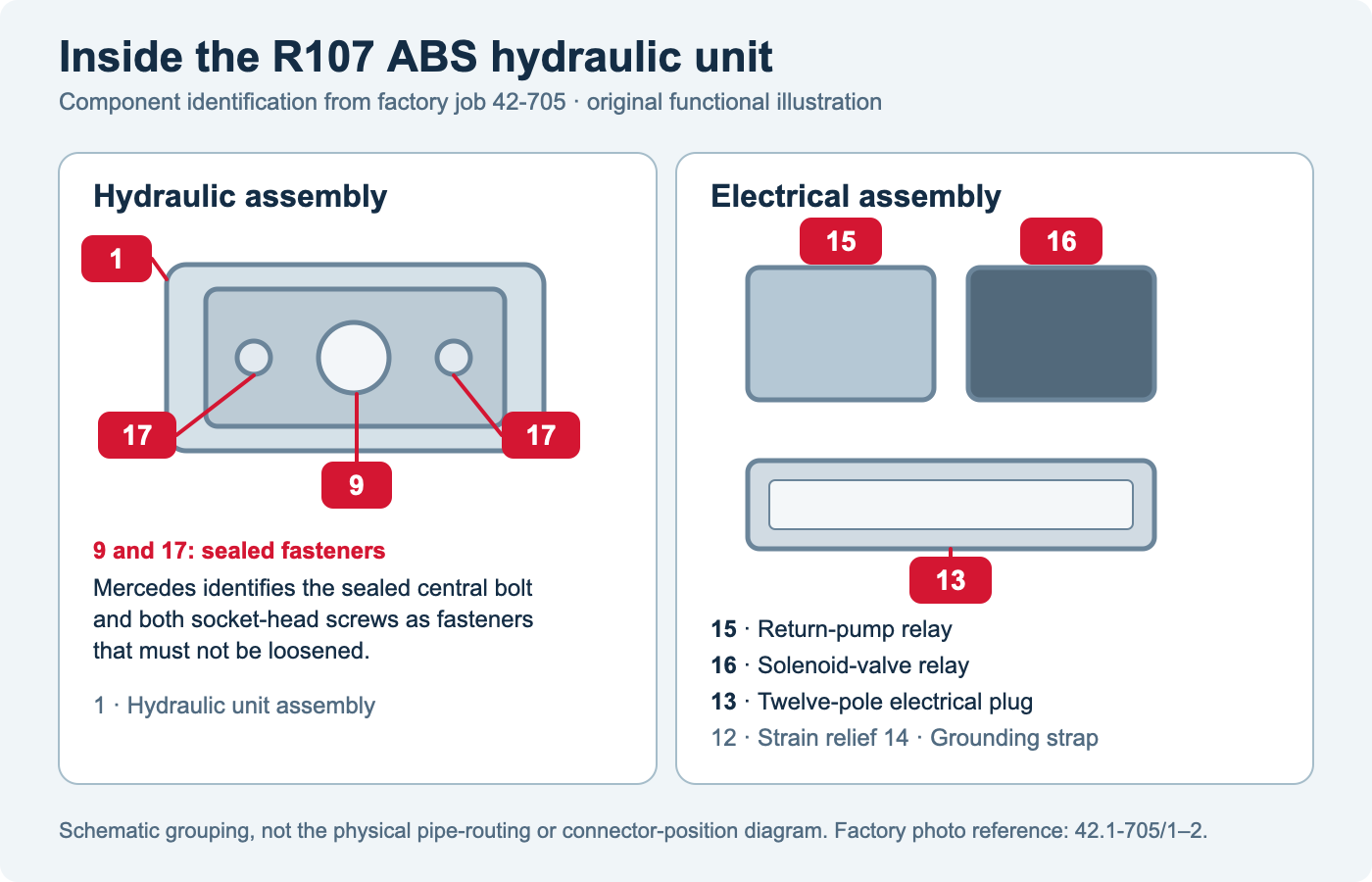
The factory photographs distinguish the hydraulic unit (1) and sealed fasteners (9 and 17) from the electrical plug (13), strain relief (12), grounding strap (14) and the two replaceable relays (15 and 16). The illustration groups these components by function rather than reproducing their physical mounting positions.
What does factory procedure 42-705 involve?
Replacing the unit opens the hydraulic brake system. This section explains what a qualified repairer will do and what to check before the car comes back into service. It is not a substitute for the factory instructions, the correct brake-service tools or the completed ABS test program.
Before the replacement
Verify the replacement hydraulic unit’s identification and its suitability for your chassis. Establish the assignment of the five brake pipes before disconnecting them, and prepare clean plugs for the opened lines and ports. The factory specifies an open double-box wrench for loosening the brake pipes. Ordinary open-ended spanners can damage brake-pipe fitting flats.
With the ignition switched off and battery ground disconnected, the lines are disconnected and capped promptly to keep the system clean. The repairer removes the cover, disconnects the pump motor ground and the secured twelve-pole electrical plug, and releases the unit from its mounting bracket.
Getting the pipes back in the correct place
This is the part of the job where guessing is especially dangerous. The factory unit identifies the two connections from the tandem master cylinder and the three outputs to the brakes. The uppercase V identifies the front-axle master-cylinder circuit, uppercase H the rear-axle master-cylinder circuit, and lowercase h the rear brake output. The lowercase l and r identify the outputs to the left and right front brakes respectively.
Don’t rely on the shape of an old pipe or on a generic photograph from another Mercedes. Confirm the actual markings and trace each line against the appropriate factory diagram.
The repairer reinstalls the hydraulic unit, grounding strap and electrical plug with its strain relief, then refits the cover and reconnects the identified pipes. The factory gives 14 Nm (approximately 10.3 lb-ft) for the hydraulic-unit brake-line connections, using an appropriate open-box torque socket. That figure is not a general torque specification for other brake fittings.
Before driving again
The brake system must be bled and inspected for leaks using the applicable factory brake procedures. Mercedes also requires completion of its ABS test program after replacing the hydraulic assembly. A warning lamp that goes out is not sufficient proof that the connections, hydraulic pressure control and braking system are sound.
The successful job is not the moment the new pump is bolted into place. It is the moment the verified braking system is ready to return to service.
What to ask the shop
If someone has already suggested a replacement pump, ask which test identified a fault in the hydraulic unit, whether the relays and power supply were checked, and how the replacement part was matched to your car. Ask for the brake bleeding, leak inspection and ABS test results as well. Those questions are more useful than purchasing parts in the hope that one of them cures the warning light.
For more about the speed signals the control unit relies on, see our guides to the front ABS sensor and rear ABS sensor. If the warning lamp is your main concern, start with understanding the R107 ABS warning light.
Sources
- Mercedes-Benz Model 107 Workshop Manual, procedure 42-700, printed 42.1-700/2–6, /7–10, /13 (layout, pressure control, relay modification, sensors and operating principle).
- Mercedes-Benz Model 107 Workshop Manual, procedure 42-705, printed 42.1-705/1–2 (hydraulic unit removal and installation).
- Mercedes-Benz Model 107 Workshop Manual, procedure 42-710, printed 42.1-710/1 (replaceable relay and overvoltage protection).
- Mercedes-Benz Model 107 Workshop Manual, procedure 42-720, initial test-program pages, printed 42.1-720/1–12 (diagnostic checks; use complete applicable procedure).
- Mercedes-Benz Media: World premiere in 1978 in the Mercedes-Benz S-Class: Anti-lock braking system 40 years old.
- Original 1988 Mercedes-Benz 560SL owner’s manual (ABS section, printed p. 62; hosted scan).