A classic Mercedes diesel that is reluctant to start can send you down a long list of possible repairs. Before committing to injectors or an engine overhaul, find out whether each cylinder can actually build enough compression. A properly performed compression test is one of the useful ways to do that.
Mercedes published its own pressure-test procedure as workshop job 00-115. For the non-turbo W123 diesels covered here, the factory data specifies both a normal pressure range and how different the cylinders may be from one another. Those are separate measurements, and both matter.
Which W123 diesels does this guide cover?
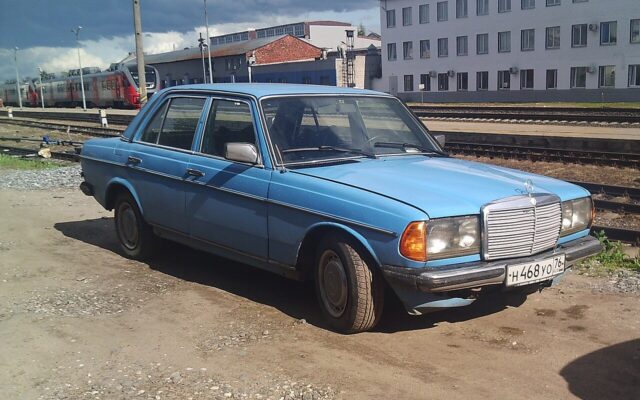
The factory model survey in the surviving non-turbo OM615/616/617 engine-service scan lists these W123 variants:
- 240D, chassis 123.123, engine OM616.912 (1977 onward; no last year stated in the scan).
- 300D, chassis 123.130, engine OM617.912 (1977–1981).
- 300CD, chassis 123.150, engine OM617.912 (1978–1981).
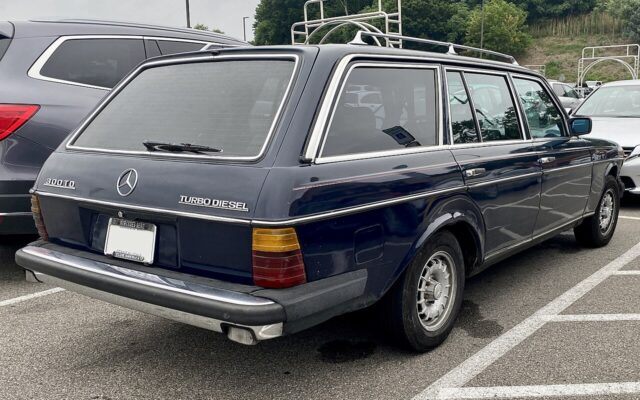
- 300TD, chassis 123.190, engine OM617.912 (1979–1980).
Those dates are from this particular factory survey, not a complete worldwide production list. The guide does not establish specifications for a turbocharged OM617.95 or a replacement engine. Confirm the installed engine number and relevant literature before interpreting results.
Why compression is so important in a classic diesel
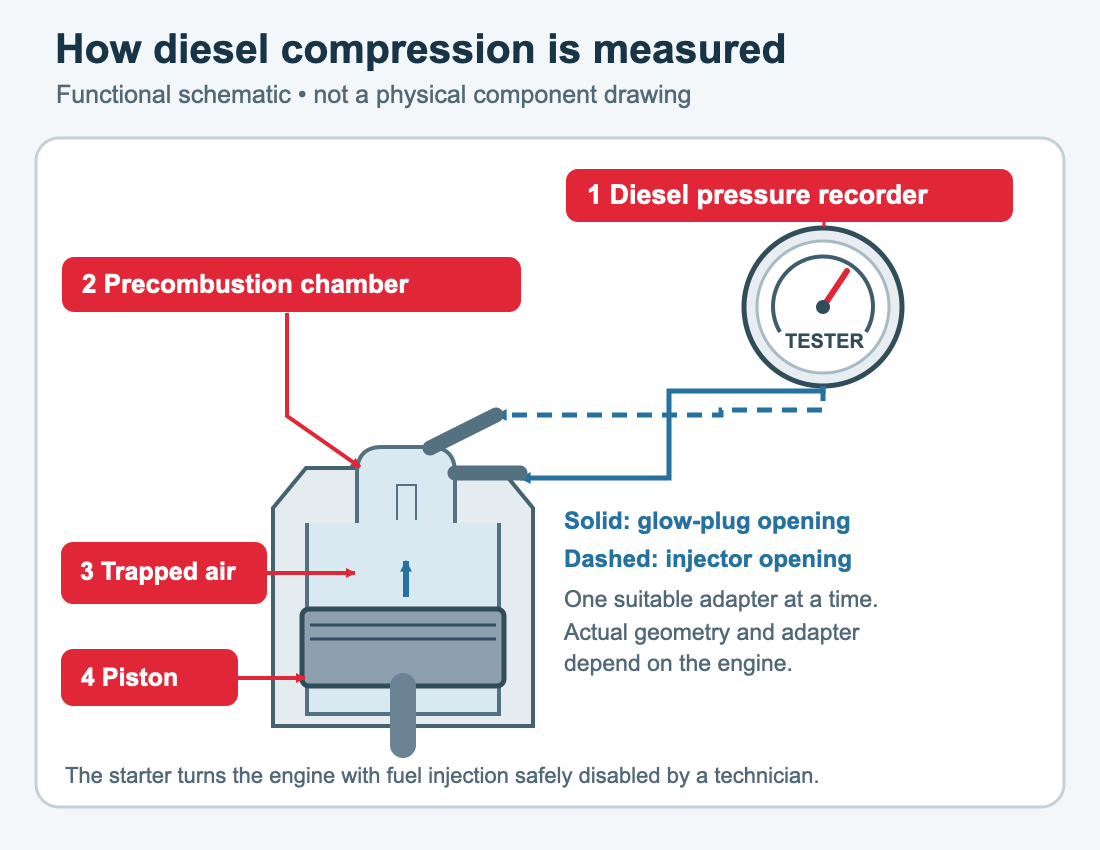
These W123 diesels were sold in the 1970s and early 1980s with mechanically metered fuel injection. Diesel fuel ignites in the hot compressed air inside the cylinder and precombustion system rather than with a gasoline-style ignition spark. When the piston rises and the valves are closed, the air is squeezed into a much smaller space. In the schematic, the piston (4) compresses the trapped air (3), which communicates with the precombustion chamber (2). A diesel pressure recorder (1) measures that pressure through a suitable service adapter.
If a cylinder leaks past a valve, piston ring or head gasket, it may not build pressure as expected. This is why a compression check helps separate a possible mechanical problem from a fuel supply or preheating complaint.
A difficult cold start is not proof of low compression. A slow starter, a weak battery, defective glow plugs or problems in the fuel system may produce similar symptoms. For that reason, the compression check is part of the diagnosis rather than a replacement for it.
Mercedes factory compression figures
Workshop job 00-115 gives the following readings for a hot engine, with coolant at 80°C (176°F). These are gauge-pressure readings, not the engine’s compression ratio.
- Normal compression: 22–24 bar, approximately 319–348 psi.
- Approximate minimum compression: 15 bar, approximately 218 psi.
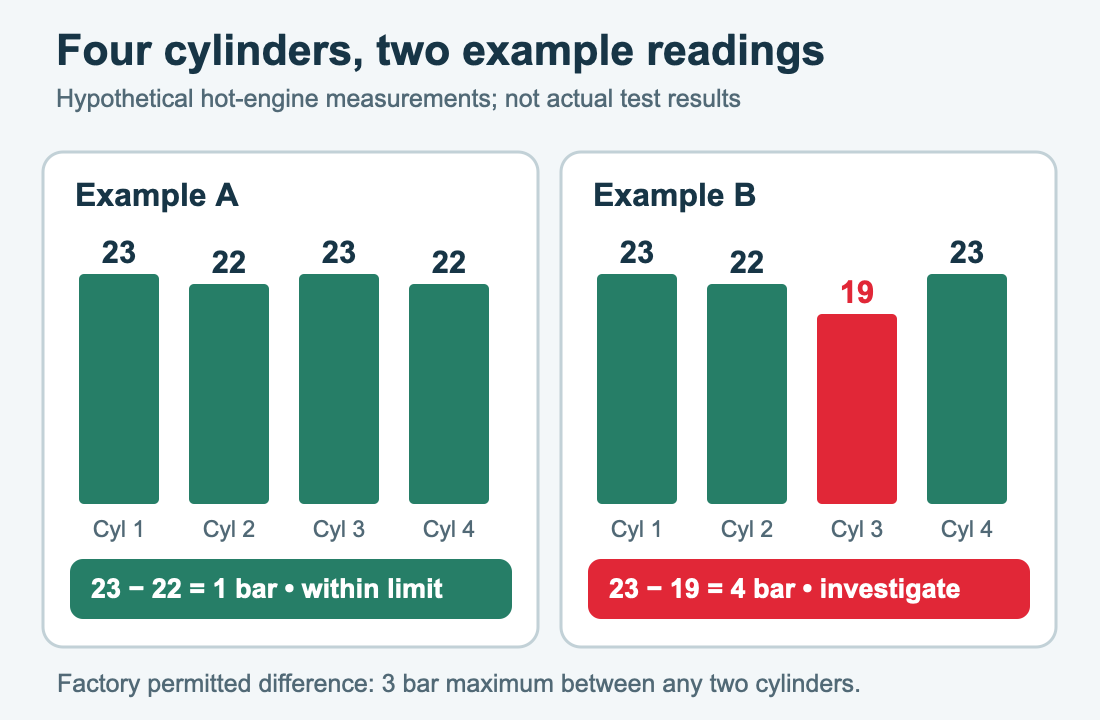
- Largest permitted difference between any two cylinders: 3 bar, approximately 44 psi.
The minimum is not a healthy target. An engine with a low but even set of numbers should still be investigated; an uneven set may deserve attention even when each number is above the minimum.
Compare the numbers, not just the lowest cylinder
Imagine a four-cylinder 240D with four readings of 23, 22, 23 and 22 bar. Those example figures fit the normal range, and the maximum cylinder-to-cylinder difference is just 1 bar. They are not proof that every part of the engine is perfect.
Now imagine readings of 23, 22, 19 and 23 bar. Although the lowest reading exceeds the approximate minimum, the difference between the highest and lowest is 4 bar. That is more than the cited factory limit. The next step should be a consistent retest and further diagnosis, not guessing which part needs replacement.
What the factory test involves
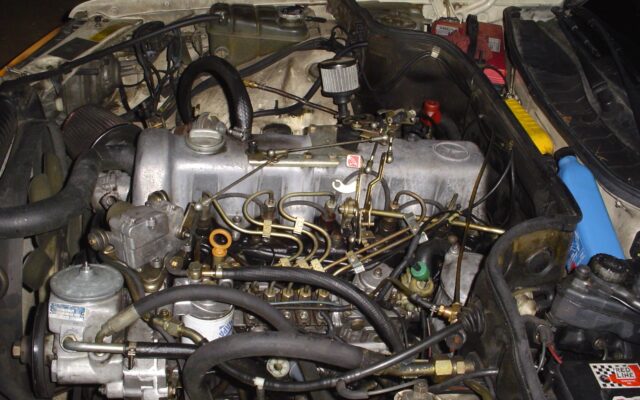
The factory document identifies a compression pressure recorder with suitable adapters and a workshop starter-control tool. It illustrates two alternative gauge connections: through the glow-plug opening, or at the precombustion chamber after removing the injector. These are alternatives, not two gauges used simultaneously. The upper chamber and lower cylinder communicate, allowing the recorder to measure pressure as the engine is cranked. The solid and dashed lines in the schematic identify the two alternative routes, not the actual shape or position of the fittings.
The service job describes neutral transmission position, safely preventing injection on mechanically governed pumps, clearing deposits before attaching the recorder and cranking for eight engine revolutions for each measurement. It also distinguishes throttle arrangements: the general full-throttle test instruction does not apply to OM617 engines or the mechanically governed OM615/616 variants, which have no throttle valve. A workshop needs the instructions for the actual pump configuration, not a generic compression-test procedure.
Because a test involves a warm engine, exposed rotating equipment, high-pressure fuel parts and a powerful starter, this guide is not an instruction to bridge starter terminals or start the engine with components removed. Let an experienced diesel technician control cranking, secure the vehicle, disable injection correctly, select the correct adapters and protect the open connections.
If injector removal is chosen, the factory job calls for new nozzle plates during refitting. It also gives tightening torques specific to the original hardware. Confirm the correct parts and service specification for the fitted engine rather than applying a generic tightening figure.
Useful testing equipment
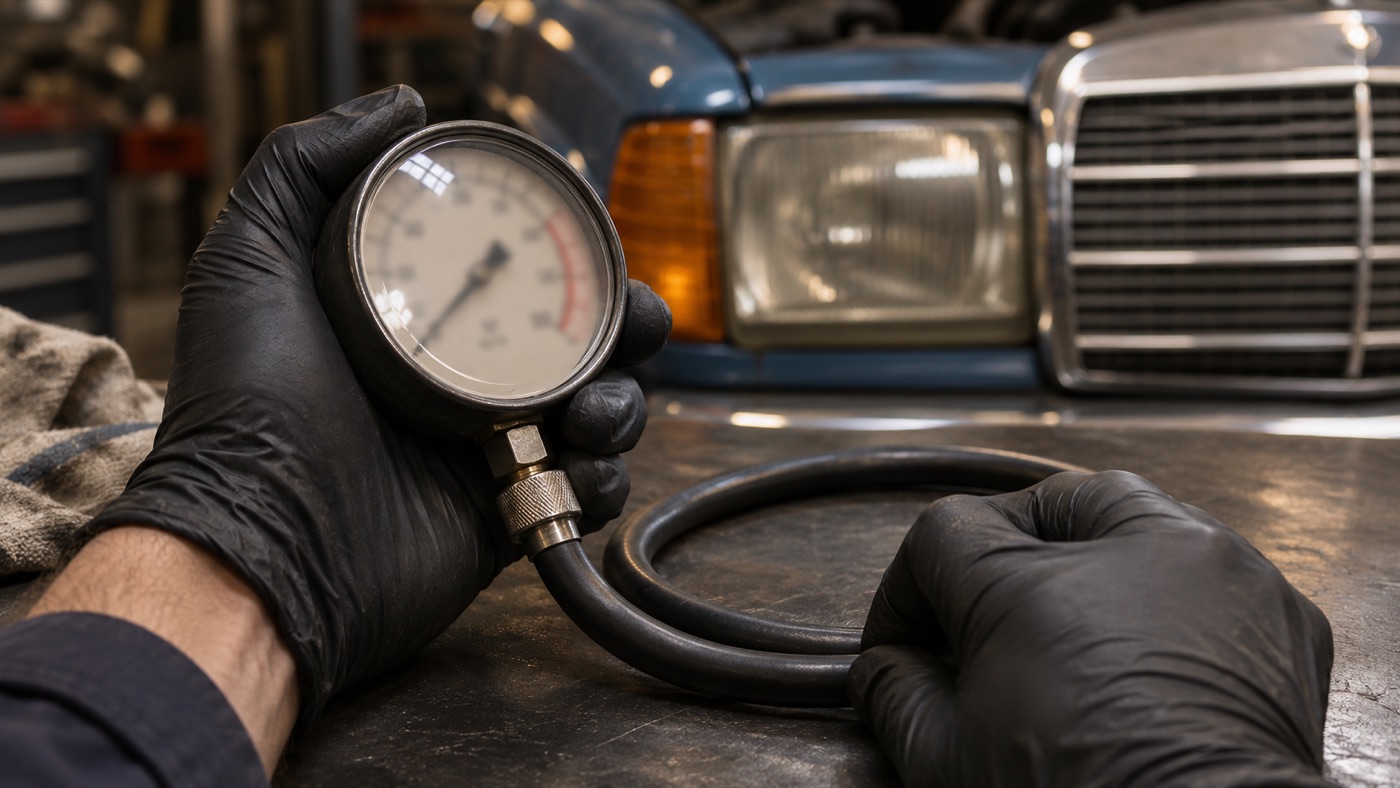
The important tool is a diesel compression tester with an appropriate pressure range, suitable service adapters and a means of recording each cylinder separately. A gasoline-engine tester or an adapter that merely appears to fit may produce a wrong result or be unsafe.
If you don’t already have the tools needed for this job, here are a few useful options available on Amazon (affiliate links). I may earn a commission from purchases made through these links.
- Diesel compression tester kit — confirm the pressure rating and exact adapter suitability for the installed engine.
- Rechargeable LED mechanic inspection light — inspect access and connections with the engine off.
- Mechanic’s digital multimeter — useful for a technician checking battery and starting-system condition before interpreting the test.
These are general tool searches, not specific confirmed fitment or current inventory claims.
The next step when compression is low
The factory job directs the technician to a separate cylinder leakage test, job 00-120, when the engine does not attain minimum compression. The two tests answer different questions. Compression testing measures the pressure reached during cranking; cylinder leakage testing can help investigate where air escapes.
Rather than ordering a rebuild from one reading, ask for the engine number, coolant temperature, testing route, recording method and results for each cylinder. If a reading is unexpectedly low, verify that the setup and cranking conditions were consistent before drawing conclusions.
For broader ownership context, see Mercedes 300D (OM617): reliability, MPG and what goes wrong or Mercedes diesel glow plugs and relay: cold-start fixes.
Factory references: Mercedes workshop job 00-115, printed pages 00.4-115/1 and /2 (PDF viewer pages 11–12); model survey 0.8-005/1 (PDF 2), in the Mercedes OM615/616/617 non-turbo engine-service scan. The partial scan has no confirmed title page or edition. Job 00-120 begins on PDF page 13 and is cited only as the separate follow-up referred to in job 00-115.